Showing posts with label kosher wine. Show all posts

Tuesday, September 20, 2011

Looking for a great red wine for Rosh Hashana?

Looking for a great red wine to start your Rosh Hashana with?


Well I have been busy lately writing some wine reviews.

Firstly:


Ramat HaGolan (Golan Heights) Winery Yarden Mount Hermon Red 2009 versus Psagot "Edom" Blend 2009.

http://rebmordechaireviews.blogspot.com/2011/09/tale-of-two-wine-blends.html


Followed by:
Har Odem (Odem Mountain) Volcanic Merlot 2009

http://rebmordechaireviews.blogspot.com/2011/09/har-odem-odem-mountain-volcanic-merlot.html


And lastly:
Dalton Reserve Merlot 2007


Sunday, September 18, 2011

A tribute to Daniel Rogov


I wish to give tribute to Israel’s first and foremost wine expert and critic, Daniel Rogov, who sadly passed away this month. Baruch Dayan Emes. Daniel Rogov was actually a pen name, his real name being David Joroff.
Oh how I remember when he used to write Israeli restaurant reviews in the Jerusalem Post back in the 1980s. He regularly incensed me with his reviews of non-kosher restaurants and recommendations of treif food. I remember thinking that there are thousands of treif food and drink reviews all over the world published every week. Was it too much to ask for that Israel’s leading English language newspaper review kosher restaurants and publish recipes with only kosher ingredients? I was not alone in my thinking.
Daniel, like the majority of Russian Jews who emigrated to the West in the 1930s, was a product of 2,000 years of assimilation, pogroms, starvation and general Jewish persecution. Most Jews who escaped the horrors of Europe just wanted to live a comfortable life and leave the Shtetl and “all that Jewish thing” behind. Remaining Torah observant was the exception not the rule. Many so called experts predicted the demise of Orthodox Jewry and Mitzvah observance by no later than the 1960s. How wrong they were but looking back at the state of World Jewry in the 1930s and 40s, how very understandable that feeling must have been.
I have heard Rav Zev Leff say in many of his shiurim that we Shomrei Shabbos Jews living today in the 21st century do not fully appreciate the heroism of those simple Yidden who remained loyal to the Rebeinu Shel Olam, Avinu Malkeinu when Orthodox Judaism was probably as popular as a skin rash. We should look back in awe at those holy champions who sent their children to Torah schools, refused to work on Shabbos and refused to buy treif food when they hardly had any money to feed their own children as it was. Despite all their trials, Shabbos in their homes was so sweet and overflowing with kedusha. How seductive assimilation must have been and understandable it is that the vast majority succumbed and compromised on their Judaism. Who are we to judge Jews like Rogov?  We who did not experience their challenges!
Had Hakodesh Baruch Hu not had rachmanus upon Klal Yisrael and sent the likes of Rav Moshe Feinstein (zt”l) and Rav Shlomo Zalman Aubach (zt”l) as well as many other Torah giants to save Klal Yisrael, who knows what would have happened?
Back in the 1980s, I don’t suppose there weren’t many if any Shomrei  Mitzvos food and wine experts out there with the talent to write professional and objective reviews. Despite taking a lot of (in my opinion) legitimate flak from those who condemned his promotion of treif food and saw him as “the enemy” in the war against assimilation, Daniel doesn’t seem to have become anti-religious in any way. Instead of ridiculing kosher food and wine, Daniel instead took the position that kosher consumers had every right to insist the same quality in food and wine as the gentile world's equivalent. It is no exaggeration to say that Daniel was in a large part, responsible for the tremendous success of the award winning Israeli Wine industry we have today and the abundance of excellent kosher Israeli wineries which spoil us rotten with their varieties and elegance and sophistication, considered as good as, if not the best in the world.
Daniel, at least in the beginning, almost single handedly waged (what was considered at the time) and almost impossible campaign against the world who associated kosher wine with sweet cough syrup like liquid, and he won! Today, people all over the world enjoy “Made in Israel” quality wines which brings much needed exports as well as associating excellence with something made in Israel. Most importantly however, Daniel’s legacy will be that today’s Frum Jews can raise the kedusha of their Shabbos Kiddush like no other previous generation by the hidur mitzvah of using a suburb quality kosher wine grown in in the soil of Eretz Yisrael, thanks to Daniel.
Many Rabbonim teach that it is preferable to use unsweetened wine for Kiddush as well as the mitzvah of the Arbah Kosos on Leil HaSeder. The reason being that sweetened wine was not suitable for use in the Beis HaMikdash service. Daniel Rogov, with his unique Yiddishe insight explains that the Land Of Israel before the destruction and exile of the Jewish people was a major wine producer (as is confirmed by certain Mishniot). The knowledge of making good kosher wine was lost however when we were sent into Golus. All over Europe, the non-Jews issued harsh decrees forbidding Jews from owning land or even being partners with a goy in having a share in a field. Consequently the Jewish community was forced to buy grapes from the local food markets in order to make kosher wine. These grapes were of course of the eating variety and not meant for wine making. To try and compensate for the poor quality grapes that produced bitter wine, the kosher wine maker was forced to add a lot of sugar. This is how, according to Daniel, we came to associate kosher wines with what is in fact “sweet alcoholic syrup”.
Now that we are back in our land after 2,000 years of exile (Baruch Hashem), Israel has quickly relearned all the wine making skills we once had by adopting skills from the French and Californians and even resurrected a few ancient skills of our own from examinations of archaeological digs. It would seem to me that the continued use of sweet sugary so called "Kiddush wine" for the mitzvos actually perpetuates the old anti-Semitic decree!
It is said that the Vilna Gaon put on his Shabbos Clothes to meet the first batch of kosher wine arriving in Vilna from Eretz Yisrael. The legend goes that the first batches were pretty awful stuff yet the Vilna Gaon insisted that wine from Eretz Yisrael took priority over better quality wine made in Chutz LaAeretz when it came to the mitzvah of Kiddush. Like the Vilna Gaon, Daniel’s actions and efforts in promoting quality kosher wine has made sure that wine from Eretz Yisrael today has become the preferred wine for most Shomrei Shabbos Jews all over the world.
May Daniel Rogov's name be remembered for a blessing, zichrono Lebracha.

Wednesday, July 13, 2011

A visit to Har Odem winery in Moshav Odem in teh Golan Heights

I have a new winery review on my Review blog.


Read and enjoy the BBQ fresh salmon...


Sunday, June 12, 2011

Ella Valley wines review


In this blog I review two wines from the Ella Valley winery.

Ella Valley Pinot Noir 2005 NIS 119
Ella Valley Chardonnay 2007 NIS 69

See my Review blog here:

http://rebmordechaireviews.blogspot.com/2011/06/ella-valley-wines.html

Thursday, June 2, 2011

Gvaot Herodion Cabernet Sauvignon 2009 and Domain Netofa Rose 2009

I have a new blog post on two lovely wines from small Israeli wineries here on my Review blog:

Enjoy! Click on the link below.

http://rebmordechaireviews.blogspot.com/2011/06/gvaot-herodion-cabernet-sauvignon-2009.html

Thursday, January 20, 2011

Teperberg-1870 “Terra range” Emerald Riesling 2009 (Semi Sweet White)


This wine has been popping up all over the place recently. I saw it in all the wine shops in Machane Yehuda this week for around NIS 60*.  Browsing the shelves of my local supermarket, I saw this Teperberg on sale for NIS 31. I wouldn’t usually have even considered buying an Emerald Riesling but as this was Teperberg and on sale for half price, I reconsidered.

Emerald Riesling (pronounced “Reezling”) is a Californian hybrid invention whose parents are the Riesling and Muscadelle grapes.
The Riesling, also known as "German Riesling" comes from the area of Germany and Austria. It is a dry grape that has traditionally needed some sweetener to make it palatable. This was either by blending it with a sweet grape or, for the cheaper wines, adding sugar.
The Muscadelle grape comes from the French region of Bordeaux. It is a sweet light grape.
At least on paper, it does make sense making a hybrid of these two contrasting grapes. In practice though, the product can suffer from a lack of body and taste and has a reputation for being a cheap wine, not to be taken that seriously. However, for some reason, this grape has met with quite a bit of success here in Israel over the years. Many Israelis it seems, have a sweet tooth when it comes to their wines.
So, despite knowing its reputation, not being a snob and having recently reviewed other Teperberg wines (as well as the incentive of the sale price) , I decided that we would give it a try for Shabbos morning Kiddush.
The first thing I noticed from the label is that this wine is from Teperberg’s cheaper range called “Terra” This is what the Teperberg Internet site has to say about it:
The Emerald Riesling wine is conceived from white grapes, a creation of the University of California’s Dr. Harold Olmo, who cross-bred Riesling with Muscadelle grape varieties. The Muscadelle-Riesling cross yields a grape variety which is rich in acidity and aromas yet delicate in taste. Consequently, the Emerald Riesling is vastly used as a blended wine component although many wineries worldwide use these grapes to produce a superb semi-dry white wine that holds its own. Contrary to the rest of the world, the Emerald Riesling is an extremely popular grape variety in Israel and many long for its sweet, lush taste throughout the country.
We opened the bottle. The initial aroma was one of sweet white Kiddush ("Mascati" style) grape juice and syrupy sultanas. Pouring the wine out into our Kiddush glasses, we observed a pleasant light yellow colour quite similar to a Chardonnay. Isn't an Emerald Riesling supposed to be greenish is colour? Never mind.
Let me say up front that I do not care for sweet wines and was slightly worried that this would be too sugary for me. Indeed, as I have already described,  the aroma certainly gave an indication that this would be sherry like syupy sweet but I noticed that the label states that the wine is only 75 calories/100ml which seemed to indicate that it was not that bad. A sweet wine would be 90 calories plus!

Drinking the wine brought varied opinions from my family. My wife liked the sweetness but said that it was too heavy for her taste. My kids really enjoyed it though. They described it as “fun to taste”. As for me, well, it was too sweet for my palette. However, I could see what my kids liked about it. It has a medium body with an initially delicate sweetness that turns into a slightly dryer aftertaste. This left you with the impression that it wasn’t as sweet as you at first thought.
Conclusions:
A pleasant enough wine with no nasty surprises, but without sufficient character to be taken seriously. This is only my opinion though. My kids said that they really enjoyed it and would like to drink it again. So, if you do enjoy a good semi-sweet wine, this is not a bad example of one.
Recommended for those with a sweet tooth.

* Talking of Machane Yehuda. My son and I were looking at the whisky prices in the wine stores. They had a good selection of single malts there. However, by the look of all the dust on the cartons, no one is buying them and for good reason. The prices were simply outrageous! NIS 499 for a standard “The Glenlivet 12 year old”.
This whisky is around NIS 150 for a 1 litre bottle in the “Duty Free” and probably only slightly more expensive in the British supermarkets. How about a “The Glenlivet French Oak finish 15 year old” for NIS 899?
The “Duty Free” price is around NIS 200. Exactly how much TAX is on whisky in Israel? Googling this question did not return any definite results but it seems that there is around 200% import tax on a bottle of whisky. However, the tax on Vodka is a lot less! Now, why would that be? “Ya Ne Znayu. Da”!, as they say in Russian.

Sunday, November 28, 2010

Teperberg Cabernet Sauvignon Reserve and Chardonnay Reserve


Teperberg vinyard, Ella valley
Teperberg winery is situated just outside Beit Shemesh with vineyards primarily in the Ella valley. The company was founded in 1870 in Meah Shaarim by the family Teperberg under the name "Efrat Wines". For over 100 years it has produced sweet Kiddush wine for the religious market with the highest kosher certification.

But in the early 1990s they decided to experiment with more refined wines. Because of its reputation for cheap Kiddush wines, the family business decided to change its company name to Teperberg 1870 and to market itself as a small boutique vinery despite being actually one of Israel's largest wineries!

Their cheap and cheerful Efrat range is still sold under the Efrat label in Israeli supermarkets. I have already mentioned that their White Zinfandel (around NIS 30) is actually quite good. Served straight from the fridge, it has a beautiful blush colour, floral perfume aroma and deliciously light sweet refreshing taste. Their Merlot and Cabernet Sauvignon are what you would expect from NIS 30 wine. I'll say no more about them.

"Yayin Ismach"Wine shop on 3 Yaakov Meir Street

Last week I was taking a walk through Geula when I came across this tiny Wine shop called "Yayin Ismach" on 3 Yaakov Meir Street, one of the small turnings off of Malke Yisrael. It's actually half a shop, sharing the other half with a tie shop.

The owner is a young man named Avi who I witnessed was very patient with every customer who walked in. I was impressed that he voiced his opinion on wines that he had tried and even recommended wines that were cheaper than the wine the customer had in mind. For instance, an American was asking him about a NIS 200 bottle of wine from 2004 vintage. Avi told him that the 2005 vintage tasted nicer although this was NIS 60 cheaper! I could see that Avi's main intention was to build up a clientele who would be coming back on a regular basis to hear his latest recommendations.

I explained to Avi that I was very familiar with the Golan winery and wanted to try some other high quality wine from Eretz Yisrael. He directed me to the Teperberg shelf and showed me a Cabernet Sauvignon Reserve. I told him that I wanted to say Kiddush over the wine and had not had a good experience with saying Kiddush over Cabernet Sauvignon in the past due to the rough taste of the tannin on an empty stomach. Avi replied that it was true that Cabernet Sauvignon should ideally be drunk with food but this particular wine was exceptionally smooth and would be fine for Kiddush. I decided to buy the Teperberg Cabernet Sauvignon Reserve 2006 (NIS 110). Next I asked Avi if he could recommend a white wine for Shabbos morning. He directed me to the Teperberg Chardonnay Reserve 2009 (NIS 60). From experience I have found that it is best to buy a Chardonnay that is slightly matured. Being a 2009 I was a bit hesitant but again Avi told me that it tasted mature well beyond its age.
Teperberg Cabernet Sauvignon Reserve
Tasting the Wine

Before leaving for shul, we took the Cabernet Sauvignon out of the fridge to warm up for a couple of hours before opening. Returning from shul we opened the wine and let it breathe during Shalom Aleichem, Eishes Chayil and the kid's brachos. The label stated that the wine had been matured in French Oak barrels for 15 months.

Indeed, pouring the wine out into glasses brought an immediate and unmistakable sweet whiff of a musky damp wine cask from a winery storehouse. Having recently been to quite a few whisky storehouses as well as the Golan Winery winery, the aroma was very recognisable and familiar to us. The colour was a beautiful deep red berry red with a good body to it.

An Old Winery Warehouse
The musky smell was so overpowering that I was slightly worried that the wine would taste of musky storehouse cask wood, brick and cobwebs in a liquid form. I nonetheless commenced Kiddush with confidence.

Initial tasting was very surprising. A deep smooth fresh taste combined with its strong aroma seemed to transport us to the winery from whence this wine came. It was like we were sitting in the warehouse, surrounded by wine barrels, drinking this wine. It tasted of freshly squashed berries served in a damp wooden bowl. A slight dry hazelnut taste on the palette and a long heavy fruity berry aftertaste.

A very enjoyable wine yet I think the pungent musky smell of the barrel was ever so slightly over done . I wonder if a younger vintage would fair better? I'll have to go back to the shop and buy a 2007 and let you know. Definitely one  to buy again.


Teperberg Chardonnay Reserve
  Shabbos day, coming back from shul on a hot day, we always look forward to a white refreshing wine to quench our thirst after not drinking the whole morning. Out of all the white wines, Chardonnay is our favourite choice so we were really looking forward to this young Teperberg Reserve 2009.

Like all white and blush wines, we took the Teperberg straight out of the fridge just before we said Kiddush. Looking at the label it states that the Chardonnay had been matured in French oak barrels for 10 months. Opening the bottle our noses were immediately hit with the same powerful aroma of musky damp sherry barrels being stored in a winery warehouse mixed with spirit alcohol. This was certainly not what we expected from what we assumed was a young wine. My kids remarked that it smelled remarkably similar to a Glen Moray (Speyside) Single malt whisky.

Our next surprise came as I began pouring the wine. A Chardonnay should be a light yellow colour. Indeed the label states that it has a golden yellow colour. What we observed was a green colour similar to a Sauvignon Blanc.

After Kiddush I took my first sip of the wine. The barrel aroma and the heaviness of the wine were quite overpowering. To say that this wine had body was an understatement. I'd say it was well overweight. My family were likewise unimpressed. Whereas we would usually take more wine, this time nobody took seconds.

The wine sat on the table for half an hour or more. I decided to give the Teperberg another try. Now that it had had a chance to warm up to room temperature its flavour came bursting through. It now had a heavy sherry like taste with layers of complexity ranging from cider apples to hazelnuts and a hint of Speyside style whisky (that has a light and sherry like spirit - light for a whisky that is).

Here was a white wine behaving more like a heavy red! At room temperature it was a lot more interesting. However if we had wanted a heavy red wine then we would have bought one. As far as I'm concerned, a white wine ought to be light to medium body with a refreshing fruity taste. A Chardonnay ought to have more body but still retain that fresh fruity taste. The Teperberg reminded us so much of Glen Moray Single malt that we moved on to the actual whisky and forgot the wine.

If you like heavy white wine then I'd suggest you try this but remember to take it out of the fridge an hour or so before you drink it. I'd even suggest you open it and let it breathe for 20 mins. Sounds like I'm talking about a dry red wine? That's exactly my point.

Sunday, October 24, 2010

Gamla Pinot Noir 2005 and Carmel Private Collection Chardonnay 2009


On Thursday I was in the mood to take some risks as far as my choice of wine was concerned for Shabbos.

On Thursday afternoon I was browsing the "Yesh" supermarket shelves in their wine section where I came across a special offer for Carmel Mizrachi's "Private Collection" Chardonnay, vintage 2009.

Carmel's "Private Collection" is supposed to be their basic quality range, a notch higher than their budget  (cheap and nasty) SelectD range of wines, I suppose equivalent to Golan Winery's Gamla range at least as far as prices are concerned. That is the NIS 60 to NIS 80 price range.

This Chardonnay was marked down from NIS 60 to NIS 32. Now the first thing to look for in a Chardonnay is that it has a golden yellow colour as opposed to say a Sauvignon Blank of Riesling which has a greenish colour. The colour looked promising and the price enticing so I decided to give it a try.

Later that evening when I went shopping with my dear wife, I again was browsing the shelves of our local supermarket where I came across a lone bottle of Golan winery Gamla Pinot Noir 2005 hiding at the back of the shelf. The bottle was covered in dust and the label looked slightly faded. To find a wine more than 4 years old in a regular supermarket is quite a rarity and as they were selling it for the price of their 2007/8 I was tempted to buy. I held off for a few minutes though, fearful of the thought that they may not have looked after it and the contents could very well be vinegar. My excitement of this rare find however was too much to resist so I bought it. Marked price was NIS 62.

We got back from shul on the Friday night and I immediately went to open the Pinot Noir in order to let it breath between Shalom Aleichem, Aishes Chayil and the kid's brachos. I first of all used the Golan winery cork screw that we received as a present from our winery tour. This type of cork screw is called a "Waiter's corkscrew". The device opens the bottle by pulling the cork from one side only.

Upon lifting the leaver, to my dismay, the top of the cork crumbled away. Not a good sign! The cork was dry, due no doubt to years of storing the wine standing upright instead of on its side. I began to fear the worse.

In desperation, I grabbed a regular "Ballerina" style cork screw which opens the bottle by applying pressure on all sides, trying as best I could not to cork the bottle, (leaving bits of dried cork swimming in the wine).


The cork came away smoothly this time. My optimism returned as examining the rest of the cork, I found it to still be in good condition.

After the brachos I poured out the Pinot Noir noting its earthy woody smell. Using my wife's glass (my one was filled to the top) I swirled it round a little noting the muddy dull black red colour, typical of a good Pinot Noir. I took a sniff in order to establish if I could say Kiddush over it. (Had it even smelt even slightly sour I would obviously have not used it). It smelt like grapes and berries lying in the field after a good rainfall. The mixture of wet fruit and soggy earth was very pleasant. It looked or rather I should say, smelt promising.

I said Kiddush very slowly with a mixture of anticipation and trepidation. I knew that an enjoyable wine for Kiddush would be a great start to our Oneg Shabbos. On the other hand, the risk that one's first sip of Shabbos would be sour was almost too much to bare.

Kiddush completed, I drank the wine. Two swallows and then a third. My family looked expectantly for my reaction. I broke out into a broad grin. Distributing the wine as quickly as possible to give everybody else a chance to experience the wine, we all agreed that the risk had paid off. It was superb. It had a light to medium fresh earthy flavour that developed into a long lasting aftertaste of sweet soaked berries, oak and refreshing slightly muddy rain water. Truly delightful! What a find and what a price! I closed my eyes and let the wine sit in the mouth for a few seconds to really savour the depth and complexity of this trully elegant drink.

Shabbos morning we opened the Carmel Mizrachi Chardonnay 2009, straight from the fridge. The initial scent was not promising, smelling slightly acidic. However, swirling the glass around for few seconds brought out a more typical Chardonnay aroma of buttery fruit. I recited Kiddush and we drank the wine. The initial taste was good, showing that deep creamy fruity flavour. However, within a fraction of a second, my tongue was accosted by a very unpleasant fizziness that only amplified as the fruity taste dissipated in the mouth. Yuk!

Another disappointing Carmel Mizrachi and no wonder it was on half price. Someone messed up big time here. I know that this winery has recently won some international awards for its most exclusive ranges. That's all well and good but they really ought to take care that their basic quality range as sold in regular supermarkets is at least drinkable. (We threw the rest away as it wasn't even suitable for cooking with).

Sunday, October 3, 2010

Tour of the Golan Heights Winery, Sukkos 2010


On Sunday, Chol HaMoed, we travelled up to Katzrin in the Golan Heights to visit the Golan Heights Winery.

We were very lucky as we arrived at 11:15am to be told that the English Tour began at 11:30am. The price was NIS 20 per person. (Even young children are allowed). The salesgirl told us that we would be called when the tour was about to begin. It might be slightly late as they were waiting for a coach load of American tourists. We waited in the beautiful reception area until 11:50am at which point they called us on the Tannoy system.


While we were waiting we took the opportunity to check out the shop. We looked at the well stocked shelves of the reception area. There were many sales people on hand to answer questions in Hebrew and English (and I assume other languages as well). They were friendly, very knowledgeable and certainly not pushy.


As well as the entire Golan wine range, they had various styles of wine glasses, T-shirts and some books for sale. They also sold locally produced honey and olive oil in the corner of the shop. The wines were sorted by cheapest at the front (being the Yarden Har (Mount) Hermon blends, to the individual rare vintages at the very back.

The Tour

When we found the guide, she informed us that her name was Lisa and that the coach had been delayed. Consequently, she would take us on a more personal intimate tour as it was just us. So began our special private tour of the Golan Heights winery. I cannot tell you how lucky we were.

As we were all Hebrew speakers as well, it made Lisa's job a lot easier and relaxed as she could speak to us in wonderful "Hebrish" without having to search for the exact English term for technical concepts and items used by the workers in the winery. (Any English speaker who lives and works in Israel will know exactly what I mean).

As we moved out of the reception area and into the factory area Lisa explained that the Golan Heights Winery was actually one of the most modern wineries in the world and uses the latest technological advances in wine production, some pioneered in Israel. Despite producing around seven million bottles of wine a year (with some 30% going for export) it has only just over 100 workers. (I don't know whether this included the reception/sales people and tour guides).

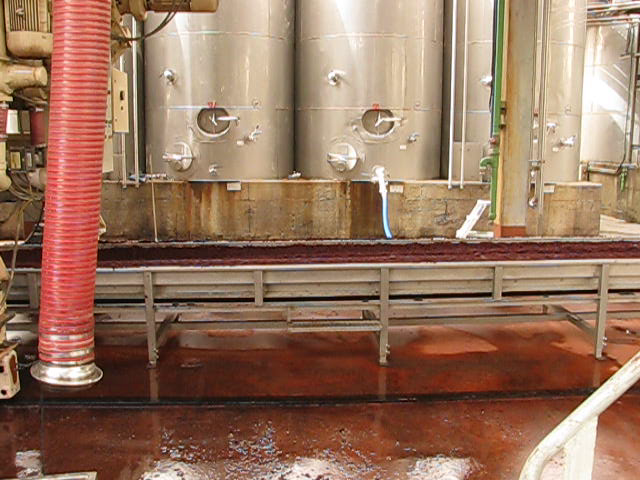
First she showed us the fermenting tanks where the newly crushed grapes are mixed with yeast.


Next we were led into the storage maturation warehouse which obviously reminded me of the whisky distilleries we had visited in August. Lisa explained that they buy premium French and American oak wine barrels.


They use new casks as well as ones that have been used once before. You can tell the difference as the used ones had wine stains all over them. Lisa explained that the longest they matured the wine was about 9-10 months before bottling them. Most wines were matured in the cask for a lot shorter time.


As we passed the filling tanks, Lisa noticed that a lorry, packed with grapes from the field had just arrived. She grinned and informed us that as we were a small group, she would give us a special treat and take us inside the filling tank area to see the grapes being processed, straight from the field. She asked one of the foremen if he could open the gates to allow us in. We had to promise not to touch anything.

We waited by the lorry. There was a lot of noise from the machinery but we were all enjoying the glorious smell of fruit and yeast all around.

After a few minutes, the lorry began to tip it's load into a massive funnel.


The contents of the scoop was sorted automatically. The grape bunches passed through whilst the left over rubbish was siphoned off up a conveyer belt which dumps the stuff into a large bin to the side.


The crushed grapes are carried along another conveyer belt where they are taken up and poured into a tank where the yeast is added.


Lisa managed to grab hold of some grapes as they fell from the skip and gave them to us. They were processing Cabernet Sauvignon grapes at that moment. We were amazed how small they were compared to the standard eating grapes you buy in the supermarket. I would have mistaken these petite wrinkly things for berries had I not been told that they were grapes.


We tasted the grapes and found them extraordinarily sweet and earthy, like concentrated juice mixed with dry mud.


The leftovers are collected and sold as animal feed to the local farmers.

Finally, we were led into the tasting room where we were given a basic tutorial in how to assess a good wine.

The Tasting Session

First Lisa informed us that the winery produces three basic ranges.

(My apologies to Lisa for this unflattering photo of her)

The Golan, Gamla and Yarden range. (There is also the top of the range for limited edition productions called "Katzrin").

All their wines are Lo Mevushal (unboiled). Lisa informed us that all their employees, including the tour guides are Shomrei Shabbat and therefore there was no problem with opening bottles.

The Golan range contains the young new wines. It is the cheapest range and meant to be drunk as soon as possible. The Gamla is the middle priced wine. Greatest time and effort however is put into their Yarden (and of course Katzrin) range.

Lisa poured us all a Yarden Chardonnay which we all thought we were very familiar with but she then informed us that this was a special "Organic" edition. You can tell the difference as this organic edition has a yellow label as apposed to the regular one which has a white label.


(The Yellow labeled Organic Chardonnay on the left)

She explained that first we should examine the colour by tilting the wine glass over a white surface. (Shabbos tablecloth would do perfectly for this). We saw that the Chardonnay had a rich golden clear yellow colour. It was a promising start.

Next she told us to smell the wine and ask us what we taught. We stuck our noises in the glass and received this light buttery fruity aroma. Lisa then demonstrated how to swirl the glass round and round which she said would unlock the true aroma of the wine.

We all did this and were truly amazed (especially my wife) that this really did bring out a much richer, more focused bouquet. The buttery fruity aroma was still there but now there were complex layers of aromas which given enough time, could be identified.

Finally we got to taste the wine. Holding it in our mouths for a few seconds in order to experience all those layers of tastes.

Next Lisa opened a Cabernet Sauvignon for us. We went through the same procedure but this time, enjoying the colour, aroma and taste of this red wine.


(Tilt the wine above a white surface to observe its colour)

(Swirl the wine around to unlock the bouquet)

I was a little apprehensive about mentioning to Lisa that although the wine was delicious going down, it left me with a rough dry taste in my mouth. I plucked up the courage and commented out loud what I was thinking.

She wasn't insulted in the least but explained that the roughness was due to the tannin in the wine and that one should really only drink Cabernet Sauvignon with food.

Tannin. One of the major elements in red wine, identifiable in tasting by the mouth puckering effect it produces. Tannin is particularly obvious in fine wines that require aging Bordeaux and Port, for example. It serves as a preservative during the aging process, gradually softening as the wines mature and allowing the fruit flavor to emerge. Tannin forms part of the sediment present in red wines that have aged for a number of years. [Source: http://www.lovewine.org/]

It is worth reading this blog post only for this one tip:

Don't use Cabertnet Sauvniyon* for Kiddush as the tannin leaves a rough taste in the mouth if drank before food. This wine should be drunk only with food, preferably something slightly fatty such as meat or cheese (obviously not at the same time!)

* The exception to this rule would be a well matured and well balanced red wine (minimum 5-10 years old?). However 99% of cabertnet Sauvniyon found in the supermarket will be young wines so my advice holds true.

Lastly, Lisa opened a Yarden Desert Muscat. Our family doesn't like sweet wines as a rule (with the exception of a semi-dry White Zinfandel for those hot summer Shabbos days, served cold straight from the fridge) but she had opened the bottle before we could object. We found it actually very pleasant having a strong brandy taste. She informed us that indeed they did add brandy to the Muscat grapes but could not tell us which brandy, the age or where it came from!

We were all given a "Yarden" cork opener as a souvenir. It's just a suggestion but I would recommend that perhaps it would be a better idea to give Yarden wine glasses away to further encourage brand loyalty and wine sells.

After the tasting session, Lisa led us back into the reception area where we began to look for items to take home with us. We thanked Lisa for a most excellent tour.
 
Expensive Prices in the shop.

Looking around I took note that the prices for their regular ranges of the Gamla and Yarden from 2007,8 and 9 were some NIS 10 to NIS 20 a bottle more expensive than the Yerushalayim supermarkets despite the labels stating that they were on discount when buying two bottles. I suppose I would have found this more annoying had I not already experienced the same phenomenon in Scotland. Whilst visiting one distillery, they had their cheapest single malt on special offer for £16. Later that day we saw the exact same bottle in the local supermarket for £12. When we returned to London, we found the local supermarket there was selling the same bottle for £10 !!!!

We decided that the best thing to do was to buy those items that are not available in the supermarkets. Consequently we ended up buying two bottles of the Limited Edition Katzrin Chardony 2007, matured in the cask for 10 months and a 2003 Yarden Pinot Noir. We intend to keep these bottles until Pesach. Be'ezrat Hashem my parents are joining us for Pesach this year so this will be an opportune moment to open them and share with my parents, the best that Israel has to offer.

 (The front of the store showing the Yarden Har Hermon blend)

(Katzrin Limited Edition Chardonay) 


(Two bottles from the the Vintage racks at the back of the store)


We also bought a set of standard wine glasses but with the Yarden emblem printed on them.


After the tour we ate a late lunch in their Sukka which was erected in the grounds of the winery, by a beautiful (man made) stream and pond. The Sukka had obviously been erected by someone religious with extra wooden strips in front of the fabric walls to make sure that we had three kosher walls. We really appreciated this as even quite a few kosher restaurants in Yerushalayim with very good hechsherim, erect Sukkos which are not fit for use. Either the fabric walls are flapping about in the breeze making the sukka posel or/and the skach is not made from suitable materials.

(The Sukka in the grounds of the Golan Heights winery)

The whole family agreed that our tour of the Golan Heights winery was the highlight of our Chol HaMoed and I could not recommend the visit to the winery highly enough.

Short Reviews of Golan Heights Winery range

The Yarden Blends labelled as White Har Hermon and Red Har Hermon (Mount Hermon) are descent enough table wines, suitable for Kiddush. They are frequenty on special offer. I've seen them as cheap as NIS 95 for three bottles.

The entire Golan Heights winery "Golan" range I find too fresh and rough for my taste. The Golan Sion Creek Dry Red for instance, I ended up using as a marinade for Roast Beef. The whites are weak and lack any depth. As cheap table wine they are hardly cheap with plenty of better options available in the supermarkets such as the cheap and cheerful Efrat winery range for around two thirds of the price of the Golan. There are also some fine Carmel wines coming out now (such as the already reviewed "Carmel Ridge Red") but avoid the "SelectD" range like the plague. Simply awful! Prices for Golan Range average NIS 30 to NIS 50.

The Gamla (medium priced) range I have already reviewed and consider these wines excellent value for money. The whole range which includes Pinot Noir, Merlot, Cabernet Sauvignon, Chardonnay, and Sauvignon Blanc (amongst others) are rich in taste and very well balanced. Prices for the Gamla range are NIS 35 to NIS 75 depending upon the wine.

The Yarden (their most expensive regular production) range are a mixed bag. I've found some excellent and others disappointing. When I pointed this out to Lisa she commented that in her opinion, the problem lies in the way that the supermarkets handle and store the older wines. Sometimes they leave them out in the sun for too long. They might store them in a place which is too hot. I have noticed that Rami Levi supermarket has very attractive looking wine shelves with bright lights shining on the bottles on every shelf. These lights heat up the bottles considerably which cannot do the wine much good at all. Prices for the Yarden range are NIS 50 to NIS 100, depending upon wine within the range and vintage. You usually won't find a bottle more than 5 years old in the supermarket. After that you'll have to go to a specialist wine store where prices reach the hundreds of shekels.

The Golan Heights winery also do a range of superb "Champaign" style sparkling wines. We tried the Gamla called "Blanc de Blank" made from their Chardonnay grapes. Unlike the kosher American sparkling wines (such as Herzog) which are sickly sweet, the Gamla is labeled "BRUT" (Dry) that is, unsweetened and makes for a far superior drink. I cannot praise this delicious sparkling wine enough. Please try it at your next simcha. Average prices are around NIS 65-75. I would guess that the Yarden "Blanc De Blank" Sparkling wine would be around NIS 150 plus.

The Limited Edition Kaztrin range will be reviewed when I've opened the bottles we bought, Be'ezrat Hashem, Pesach time. Stay tuned…