On Sunday, Chol HaMoed, we travelled up to Katzrin in the Golan Heights to visit the Golan Heights Winery.
We were very lucky as we arrived at 11:15am to be told that the English Tour began at 11:30am. The price was NIS 20 per person. (Even young children are allowed). The salesgirl told us that we would be called when the tour was about to begin. It might be slightly late as they were waiting for a coach load of American tourists. We waited in the beautiful reception area until 11:50am at which point they called us on the Tannoy system.

While we were waiting we took the opportunity to check out the shop. We looked at the well stocked shelves of the reception area. There were many sales people on hand to answer questions in Hebrew and English (and I assume other languages as well). They were friendly, very knowledgeable and certainly not pushy.

As well as the entire Golan wine range, they had various styles of wine glasses, T-shirts and some books for sale. They also sold locally produced honey and olive oil in the corner of the shop. The wines were sorted by cheapest at the front (being the Yarden Har (Mount) Hermon blends, to the individual rare vintages at the very back.
The Tour
When we found the guide, she informed us that her name was Lisa and that the coach had been delayed. Consequently, she would take us on a more personal intimate tour as it was just us. So began our special private tour of the Golan Heights winery. I cannot tell you how lucky we were.
When we found the guide, she informed us that her name was Lisa and that the coach had been delayed. Consequently, she would take us on a more personal intimate tour as it was just us. So began our special private tour of the Golan Heights winery. I cannot tell you how lucky we were.
As we were all Hebrew speakers as well, it made Lisa's job a lot easier and relaxed as she could speak to us in wonderful "Hebrish" without having to search for the exact English term for technical concepts and items used by the workers in the winery. (Any English speaker who lives and works in Israel will know exactly what I mean).
As we moved out of the reception area and into the factory area Lisa explained that the Golan Heights Winery was actually one of the most modern wineries in the world and uses the latest technological advances in wine production, some pioneered in Israel. Despite producing around seven million bottles of wine a year (with some 30% going for export) it has only just over 100 workers. (I don't know whether this included the reception/sales people and tour guides).
First she showed us the fermenting tanks where the newly crushed grapes are mixed with yeast.


Next we were led into the storage maturation warehouse which obviously reminded me of the whisky distilleries we had visited in August. Lisa explained that they buy premium French and American oak wine barrels.


They use new casks as well as ones that have been used once before. You can tell the difference as the used ones had wine stains all over them. Lisa explained that the longest they matured the wine was about 9-10 months before bottling them. Most wines were matured in the cask for a lot shorter time.

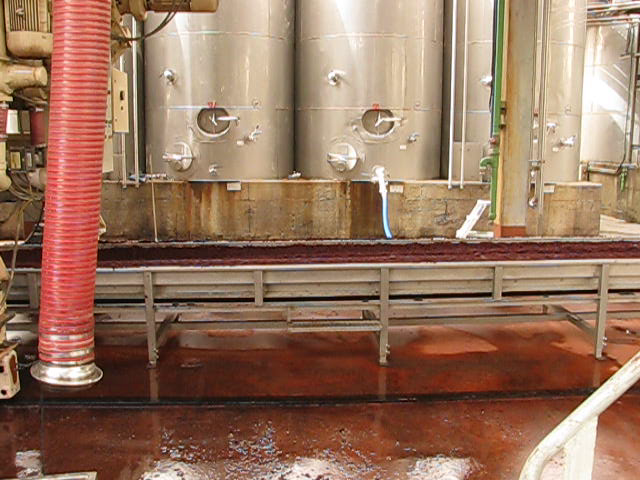
As we passed the filling tanks, Lisa noticed that a lorry, packed with grapes from the field had just arrived. She grinned and informed us that as we were a small group, she would give us a special treat and take us inside the filling tank area to see the grapes being processed, straight from the field. She asked one of the foremen if he could open the gates to allow us in. We had to promise not to touch anything.

We waited by the lorry. There was a lot of noise from the machinery but we were all enjoying the glorious smell of fruit and yeast all around.
After a few minutes, the lorry began to tip it's load into a massive funnel.


The contents of the scoop was sorted automatically. The grape bunches passed through whilst the left over rubbish was siphoned off up a conveyer belt which dumps the stuff into a large bin to the side.

The crushed grapes are carried along another conveyer belt where they are taken up and poured into a tank where the yeast is added.

Lisa managed to grab hold of some grapes as they fell from the skip and gave them to us. They were processing Cabernet Sauvignon grapes at that moment. We were amazed how small they were compared to the standard eating grapes you buy in the supermarket. I would have mistaken these petite wrinkly things for berries had I not been told that they were grapes.


We tasted the grapes and found them extraordinarily sweet and earthy, like concentrated juice mixed with dry mud.

The leftovers are collected and sold as animal feed to the local farmers.
Finally, we were led into the tasting room where we were given a basic tutorial in how to assess a good wine.
The Tasting Session
First Lisa informed us that the winery produces three basic ranges.

(My apologies to Lisa for this unflattering photo of her)
The Golan, Gamla and Yarden range. (There is also the top of the range for limited edition productions called "Katzrin").
All their wines are Lo Mevushal (unboiled). Lisa informed us that all their employees, including the tour guides are Shomrei Shabbat and therefore there was no problem with opening bottles.
The Golan range contains the young new wines. It is the cheapest range and meant to be drunk as soon as possible. The Gamla is the middle priced wine. Greatest time and effort however is put into their Yarden (and of course Katzrin) range.
Lisa poured us all a Yarden Chardonnay which we all thought we were very familiar with but she then informed us that this was a special "Organic" edition. You can tell the difference as this organic edition has a yellow label as apposed to the regular one which has a white label.

(The Yellow labeled Organic Chardonnay on the left)
She explained that first we should examine the colour by tilting the wine glass over a white surface. (Shabbos tablecloth would do perfectly for this). We saw that the Chardonnay had a rich golden clear yellow colour. It was a promising start.
Next she told us to smell the wine and ask us what we taught. We stuck our noises in the glass and received this light buttery fruity aroma. Lisa then demonstrated how to swirl the glass round and round which she said would unlock the true aroma of the wine.
We all did this and were truly amazed (especially my wife) that this really did bring out a much richer, more focused bouquet. The buttery fruity aroma was still there but now there were complex layers of aromas which given enough time, could be identified.
Finally we got to taste the wine. Holding it in our mouths for a few seconds in order to experience all those layers of tastes.
Next Lisa opened a Cabernet Sauvignon for us. We went through the same procedure but this time, enjoying the colour, aroma and taste of this red wine.


(Tilt the wine above a white surface to observe its colour)

(Swirl the wine around to unlock the bouquet)
She wasn't insulted in the least but explained that the roughness was due to the tannin in the wine and that one should really only drink Cabernet Sauvignon with food.
Tannin. One of the major elements in red wine, identifiable in tasting by the mouth puckering effect it produces. Tannin is particularly obvious in fine wines that require aging Bordeaux and Port, for example. It serves as a preservative during the aging process, gradually softening as the wines mature and allowing the fruit flavor to emerge. Tannin forms part of the sediment present in red wines that have aged for a number of years. [Source: http://www.lovewine.org/]
It is worth reading this blog post only for this one tip:
Don't use Cabertnet Sauvniyon* for Kiddush as the tannin leaves a rough taste in the mouth if drank before food. This wine should be drunk only with food, preferably something slightly fatty such as meat or cheese (obviously not at the same time!)
* The exception to this rule would be a well matured and well balanced red wine (minimum 5-10 years old?). However 99% of cabertnet Sauvniyon found in the supermarket will be young wines so my advice holds true.
Lastly, Lisa opened a Yarden Desert Muscat. Our family doesn't like sweet wines as a rule (with the exception of a semi-dry White Zinfandel for those hot summer Shabbos days, served cold straight from the fridge) but she had opened the bottle before we could object. We found it actually very pleasant having a strong brandy taste. She informed us that indeed they did add brandy to the Muscat grapes but could not tell us which brandy, the age or where it came from!

We were all given a "Yarden" cork opener as a souvenir. It's just a suggestion but I would recommend that perhaps it would be a better idea to give Yarden wine glasses away to further encourage brand loyalty and wine sells.
After the tasting session, Lisa led us back into the reception area where we began to look for items to take home with us. We thanked Lisa for a most excellent tour.
Expensive Prices in the shop.
Looking around I took note that the prices for their regular ranges of the Gamla and Yarden from 2007,8 and 9 were some NIS 10 to NIS 20 a bottle more expensive than the Yerushalayim supermarkets despite the labels stating that they were on discount when buying two bottles. I suppose I would have found this more annoying had I not already experienced the same phenomenon in Scotland. Whilst visiting one distillery, they had their cheapest single malt on special offer for £16. Later that day we saw the exact same bottle in the local supermarket for £12. When we returned to London, we found the local supermarket there was selling the same bottle for £10 !!!!
We decided that the best thing to do was to buy those items that are not available in the supermarkets. Consequently we ended up buying two bottles of the Limited Edition Katzrin Chardony 2007, matured in the cask for 10 months and a 2003 Yarden Pinot Noir. We intend to keep these bottles until Pesach. Be'ezrat Hashem my parents are joining us for Pesach this year so this will be an opportune moment to open them and share with my parents, the best that Israel has to offer.

(The front of the store showing the Yarden Har Hermon blend)

(Katzrin Limited Edition Chardonay)


(Two bottles from the the Vintage racks at the back of the store)
We also bought a set of standard wine glasses but with the Yarden emblem printed on them.

After the tour we ate a late lunch in their Sukka which was erected in the grounds of the winery, by a beautiful (man made) stream and pond. The Sukka had obviously been erected by someone religious with extra wooden strips in front of the fabric walls to make sure that we had three kosher walls. We really appreciated this as even quite a few kosher restaurants in Yerushalayim with very good hechsherim, erect Sukkos which are not fit for use. Either the fabric walls are flapping about in the breeze making the sukka posel or/and the skach is not made from suitable materials.

(The Sukka in the grounds of the Golan Heights winery)
The whole family agreed that our tour of the Golan Heights winery was the highlight of our Chol HaMoed and I could not recommend the visit to the winery highly enough.
Short Reviews of Golan Heights Winery range

 The entire Golan Heights winery "Golan" range I find too fresh and rough for my taste. The Golan Sion Creek Dry Red for instance, I ended up using as a marinade for Roast Beef. The whites are weak and lack any depth. As cheap table wine they are hardly cheap with plenty of better options available in the supermarkets such as the cheap and cheerful Efrat winery range for around two thirds of the price of the Golan. There are also some fine Carmel wines coming out now (such as the already reviewed "Carmel Ridge Red") but avoid the "SelectD" range like the plague. Simply awful! Prices for Golan Range average NIS 30 to NIS 50.
The Yarden (their most expensive regular production) range are a mixed bag. I've found some excellent and others disappointing. When I pointed this out to Lisa she commented that in her opinion, the problem lies in the way that the supermarkets handle and store the older wines. Sometimes they leave them out in the sun for too long. They might store them in a place which is too hot. I have noticed that Rami Levi supermarket has very attractive looking wine shelves with bright lights shining on the bottles on every shelf. These lights heat up the bottles considerably which cannot do the wine much good at all. Prices for the Yarden range are NIS 50 to NIS 100, depending upon wine within the range and vintage. You usually won't find a bottle more than 5 years old in the supermarket. After that you'll have to go to a specialist wine store where prices reach the hundreds of shekels.

The Golan Heights winery also do a range of superb "Champaign" style sparkling wines. We tried the Gamla called "Blanc de Blank" made from their Chardonnay grapes. Unlike the kosher American sparkling wines (such as Herzog) which are sickly sweet, the Gamla is labeled "BRUT" (Dry) that is, unsweetened and makes for a far superior drink. I cannot praise this delicious sparkling wine enough. Please try it at your next simcha. Average prices are around NIS 65-75. I would guess that the Yarden "Blanc De Blank" Sparkling wine would be around NIS 150 plus.
The Limited Edition Kaztrin range will be reviewed when I've opened the bottles we bought, Be'ezrat Hashem, Pesach time. Stay tuned…